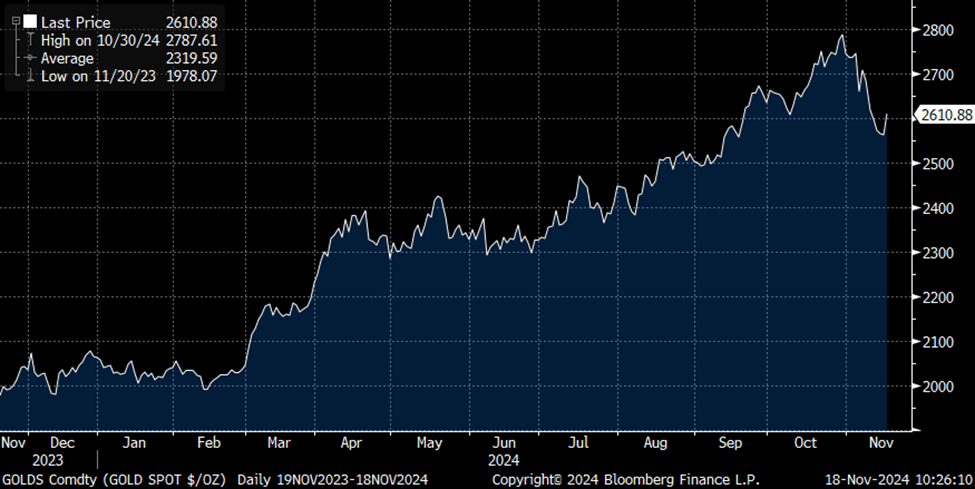
Since Donald Trump’s election victory, gold prices have dipped by 7%, driven by investor optimism around his proposed Department of Government Efficiency (DOGE), which aims to trim the federal budget.
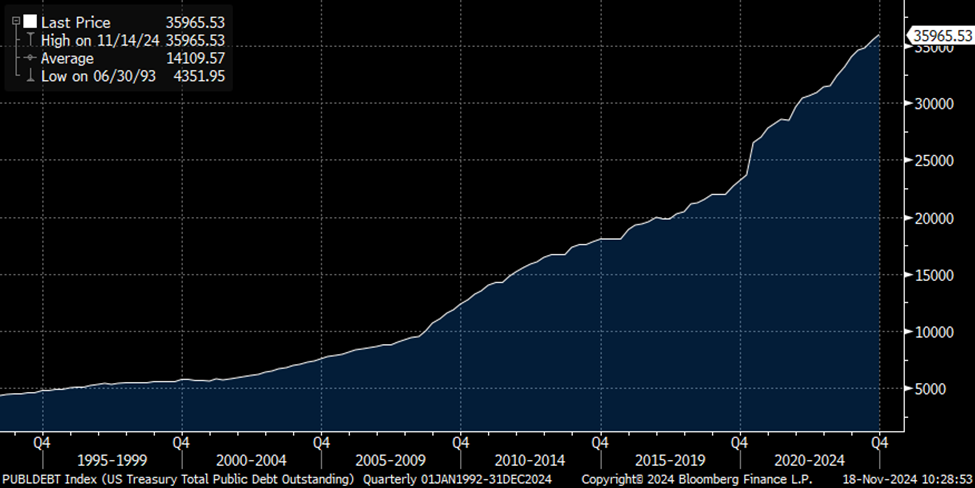
However, it’s important to recognize the bigger picture: reducing the U.S. deficit remains an enormous challenge. The U.S. national debt has now exceeded $37 trillion, a figure that has been steadily rising for the past 50 years. Regardless of party affiliation, no administration has successfully reined in spending. Despite his intentions as a fiscal conservative, even Trump added $8 trillion to the national debt during his first term, largely due to expansive tax cuts and increased spending. This highlights the complexity of tackling government debt, which continues to grow irrespective of who is in office.
The U.S. Economy Depends on Debt
Government spending accounts for over 40% of the U.S. GDP. If spending were significantly reduced, the economy would face an unprecedented crash. Yet, Trump’s Treasury Secretary frontrunner, Scott Bessent, reportedly supports a disastrous “Three Arrows” economic strategy inspired by Japan’s failed policies under Shinzo Abe.
Bessent’s plan includes:
- Keeping interest rates low or negative to stimulate borrowing.
- Launching massive debt-funded infrastructure programs to boost short-term growth.
- Expanding fiscal stimulus, further ballooning the national debt.
This approach guarantees skyrocketing debt, sustained inflation, and a weakening U.S. dollar.
Why Gold Remains Undervalued
Despite these looming risks, many investors view gold as “expensive” at current prices. But they’re missing the bigger picture. Consider this:
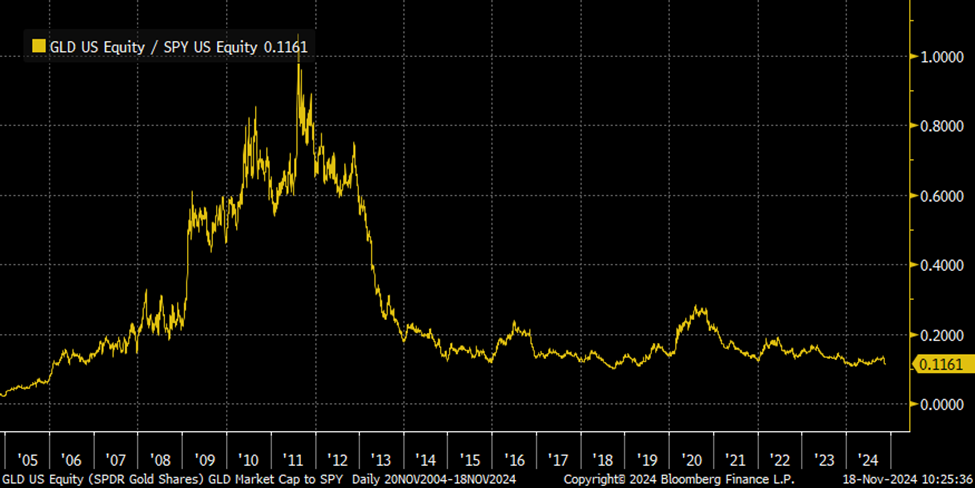
In 2011, when gold peaked at $2,000 per ounce, the GLD ETF’s market cap reached $78 billion, surpassing the SPY ETF’s market cap of $77 billion. Today, GLD’s market cap is only $72 billion—just 11% of SPY’s staggering $634 billion.
Even if the SPY ETF drops by 50%, gold prices would need to rise fivefold to restore parity. This implies gold could reach $13,000 per ounce—a conservative estimate given the current economic landscape.
A Conservative Hedge Against Economic Uncertainty
History has shown that gold is the ultimate store of value, retaining its purchasing power for over 1,000 years. In contrast, the U.S. dollar has lost over 90% of its value since the creation of the Federal Reserve. As inflation erodes wealth and government debt spirals out of control, gold remains the safest bet for conservatives looking to protect their assets.
Take Action Now
Some Gold and Silver stocks are trading at just 10% of their fair value relative to today’s gold price. This represents an unparalleled buying opportunity. As the U.S. teeters on the brink of an economic cliff, those who act now will reap the rewards of this timeless asset.
Best,
Garrett Goggin, CFA
Chief Analyst & Founder, Golden Portfolio
P.S. Gold Portfolio offers three products Golden Portfolio up 27%, Golden Portfolio 10X up 44% and Golden Portfolio IV up 146%, all well ahead of the GDX Gold Stock ETF only up 20%.
Seize this moment to secure your financial future. Gold isn’t just a hedge—it’s a long-term safeguard against the storm brewing in Washington.